

Famous Tiaras of the Gilded Heiresses
And a major announcement

There is a particular kind of glitter that belongs to the Gilded Age.
There’s the brilliance of diamonds and the depth of sapphires, and there’s also something more layered: a shimmer made up of ambition, transatlantic marriages, social reinvention, and an understanding that, while wealth could open doors, it can’t always secure belonging.
When American heiresses crossed the Atlantic in the late 19th century, they brought more than fortunes. They brought jewels. And those jewels became part of a visual language that still defines the era: tiaras worn beneath chandeliers, in drawing rooms, at court presentations, and at great society balls where lineage and money met in uneasy partnership.
These tiaras were declarations as much as they were ornaments.
Today, those glittering headpieces form a cornerstone of the Countess of Sandwich Society. Each tier reflects a jewel and a story. They also reflect the women and the moments in history when the worlds of America and Britain became irrevocably intertwined.
(Don’t know about the Countess of Sandwich Society yet? I’ll explain it at the end. But first: jewels!)

Sapphire: The Vanderbilt Tiara and the Architecture of Ambition
Few names carry the weight of Gilded Age mythology quite like Vanderbilt.
Consuelo Vanderbilt entered British aristocracy in 1895 when she married the 9th Duke of Marlborough in a union that has since become emblematic of the era’s transactional marriages.
American money, British title. Fortune exchanged for lineage.
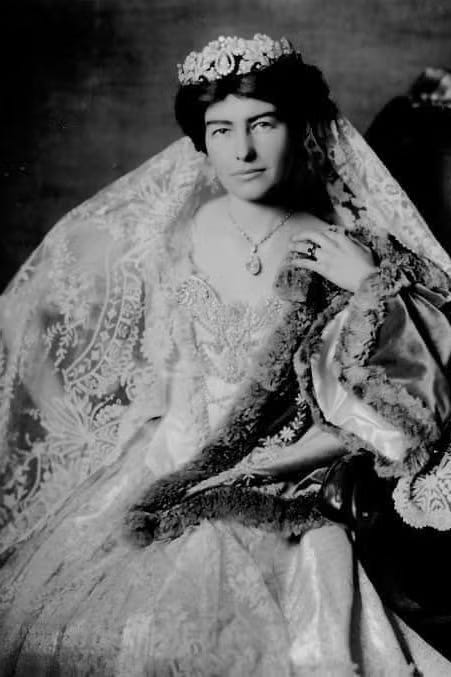
For her wedding, the Parisian house of Boucheron created an extraordinary diamond tiara, set with large pear-shaped stones in a flowing garland design. It was a masterpiece of Belle Époque craftsmanship, designed to catch candlelight and signal unmistakable presence in the great rooms of aristocratic life.
While this famous tiara was composed of diamonds, the wider Vanderbilt collection included remarkable coloured gemstones, including sapphires of exceptional depth and clarity. Together, these jewels formed part of a visual language of wealth that moved across continents and into Britain’s great houses.
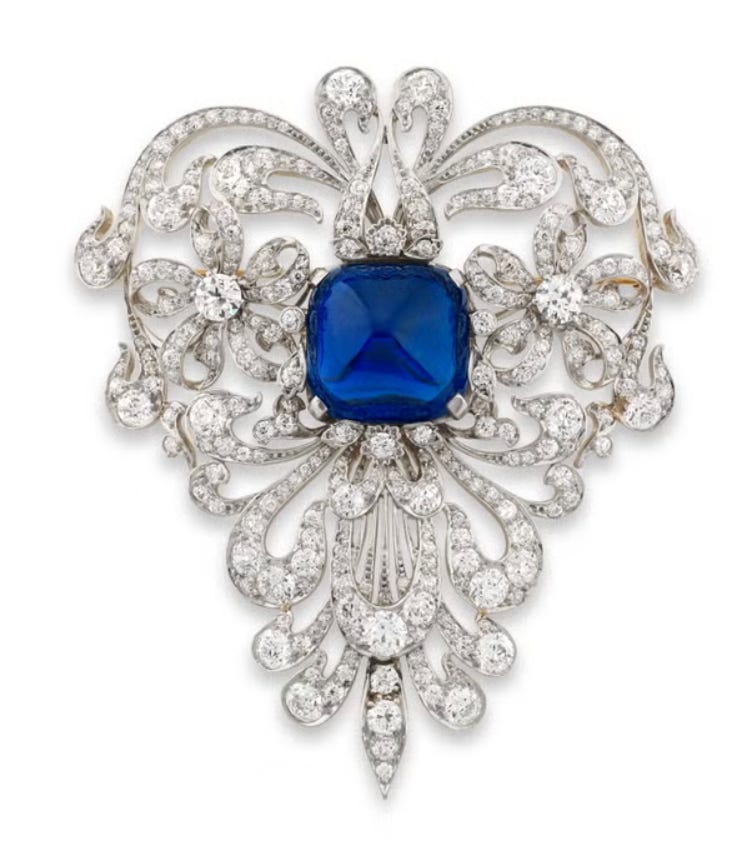
The sapphire tier, then, draws on that broader world of Vanderbilt splendour that wasn’t so much a single object, but an atmosphere. The spectrum of blue that suggests depth, intellect, and legacy.
Pearl: The Curzon Tiara and the Performance of Elegance
If sapphires announce, pearls suggest.
Mary Victoria Leiter, later Lady Curzon, became one of the most celebrated American-born figures in the British imperial world. As Vicereine of India, she occupied a role that was as theatrical as it was political, moving through ceremonies, courts, and imperial spectacle with extraordinary poise.
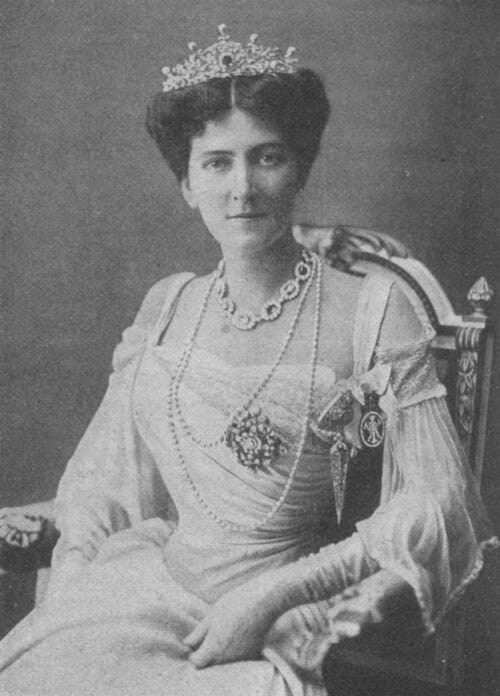
For the Delhi Durbar of 1903, the Parisian house of Boucheron created a diamond tiara in a distinctive fleur-de-lis design, worn as part of one of the most iconic ensembles of the Edwardian period.
Yet beyond the tiara itself, Lady Curzon’s image was shaped by a broader aesthetic of softness and luminosity. Pearls, frequently worn in her jewellery and across elite society, became part of the visual language of refinement that defined the age.
The pearl tier, then, draws on that cultivated elegance. Not a single jewel, but a sensibility and a glow that signals composure, grace, and the art of moving through the world with precision.
Emerald: The Manchester Tiara and the Spectacle of Arrival
The phenomenon of the American heiress marrying into the British aristocracy was well established.
Helena Zimmerman, daughter of a railway magnate, married the 9th Duke of Manchester in 1900. With her came not only wealth, but a style of glamour that was unmistakably modern.
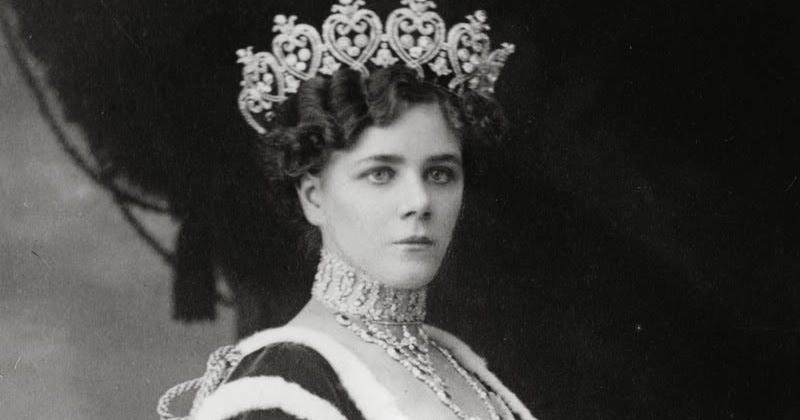
The Manchester Tiara itself was a spectacular diamond creation by Cartier, but Helena Zimmerman’s jewellery collection included striking emerald pieces, often worn alongside it, creating a visual language of brilliance and colour that defined the era.
This is the language of arrival and of entering a world and reshaping it in your own image.
Ruby: The Language of Power
By the early 20th century, the world of the Gilded Age heiress had expanded beyond marriage into performance. Court presentation, state occasions, and grand evenings demanded a visual language that could be read instantly.
Consuelo Vanderbilt and women like her moved through these spaces shaped by expectation, spectacle, and the careful construction of presence.
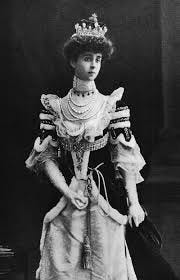
Within aristocratic jewellery of the period, ruby-set pieces formed some of the most striking elements of court dress. Necklaces, brooches, and bodice ornaments set with deep red stones created a visual intensity that stood apart from the cooler brilliance of diamonds.
These were not subtle jewels; rather, they were designed to register across vast rooms, beneath chandeliers and electric light, where colour carried further than sparkle alone.
Diamond: The Montagu Tiara and the Continuity of Lineage
Not every American woman entering the British aristocracy was simply marrying into a title. Some were entering into something far older, and making love matches while they were at it.
Alberta Sturges Montagu—American heiress and writer—married the 9th Earl of Sandwich in 1905, becoming the Countess of Sandwich, joining a family whose history stretched back centuries.
At her wedding, Alberta wore the Montagu family tiara, a diamond piece passed down through generations and worn at significant moments in the life of the family. Like many aristocratic jewels, it formed part of a larger tradition of inheritance, where objects were not simply owned, but stewarded.

Nearly a century later, I wore the same tiara at my wedding, following in Alberta’s footsteps as an American from Chicago who became a Countess of Sandwich.
From Jewels to Living History
What connects these tiaras is what they represent.
They belong to a moment when history was being negotiated in drawing rooms, in marriages, in letters, and in the powerful decisions that shaped entire families. American women crossing the Atlantic altered British aristocracy. And in doing so, they left behind objects that still carry their presence.
But these stories do not survive on their own.
Many of these women played a role in restoring, shaping, or sustaining the great houses they entered…and some of them still stand today. Historic houses require constant care, and the lives behind the portraits and the jewels only continue to exist because someone chooses to remember them.
This is where the Countess of Sandwich Society for the Preservation of Britain’s Living History begins.
The Society is a digital and cultural community dedicated to preserving and sharing the stories of Britain’s historic houses through film, research, and scholarship. It brings together everything that has grown around American Countess and Gilded Heiresses into one permanent, curated archive.
As a member, you are actually participating in the work of preservation: supporting the creation of films, the uncovering of archival material, and the telling of stories that might otherwise remain hidden.
You become part of a living archive. One that will continue to grow, evolve, and endure.
Here’s the official launch film, filmed at Mapperton, the family seat of the Earls of Sandwich. It tells the story of how this project began, and where it is going next.
And if you have been reading, watching, and following along, this is the moment to step inside it.
This is living history.
And we would love you to be part of it.
Tiara looks great
Julie,
We should have "Tiara Tuesday" every week highlighting a favorite selection of your choosing!