

Feasting in the Gilded Age
Oysters, champagne, and aspic...oh my!


In the Gilded Age, food was never just food. It was social signalling…a performance of refinement, and a piece of choreography as tightly rehearsed as any ballroom quadrille. What sat on the table mattered as much as who sat around it, and quite possibly more than anything said over it. You could learn everything about a family from the first course.
Across New York, Newport, London, and Paris, elite dining evolved in step with the age itself: industrialisation, global trade, and the sudden professionalisation of domestic service. Ingredients that once travelled no further than the nearest market now arrived from across oceans, landing on the plates of households wealthy enough to want them. Trained chefs carried the strict grammar of French haute cuisine into Anglo-American dining rooms and refused to let anyone forget the rules.
Mix all of that together and you get a food culture built on abundance, yes, but governed by precision and staged for spectacle.

Oysters: Leveller Turned Luxury Staple
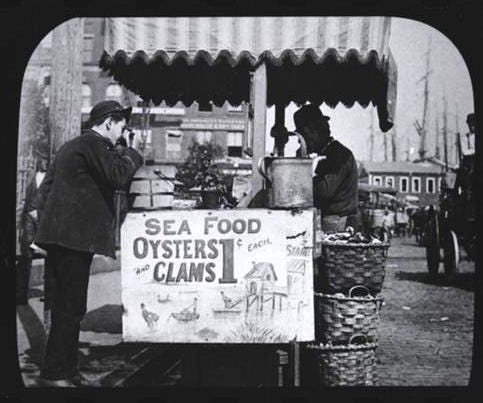
Oysters were one of the most widely consumed foods of the nineteenth century. In coastal cities like New York, they were cheap, plentiful, and everywhere, shovelled out by the dozen from street stalls and smoky taverns. But they weren’t born fancy. Before the makeover, an oyster was a common snack, slurped down by dockworkers and dowagers alike.
By the mid to late nineteenth century, though, the oyster climbed the social ladder. It never quite left the working-class plate, but at the top it acquired scale and staging. At formal dinners it opened the evening as it bedded on crushed ice. And, on the grandest nights, it was cradled in wide silver dishes that announced both plenty and welcome before a single fork was lifted.
That was the trick of the oyster, you see. The very same creature could mean everyday supper in one room and gracious hospitality in the next. And while nothing about the oyster actually changed, the theatre around it did.
New York’s oyster houses became social stages in their own right. Some were loud, crowded, and gloriously unbuttoned. Others were hushed and reserved for a wealthier clientele, who preferred their bivalves with a little more ceremony. Over time the oyster settled comfortably into both worlds at once, which makes it one of the clearest cases of culinary overlap the era produced.

Terrapin, Game and the Taste of Exclusivity
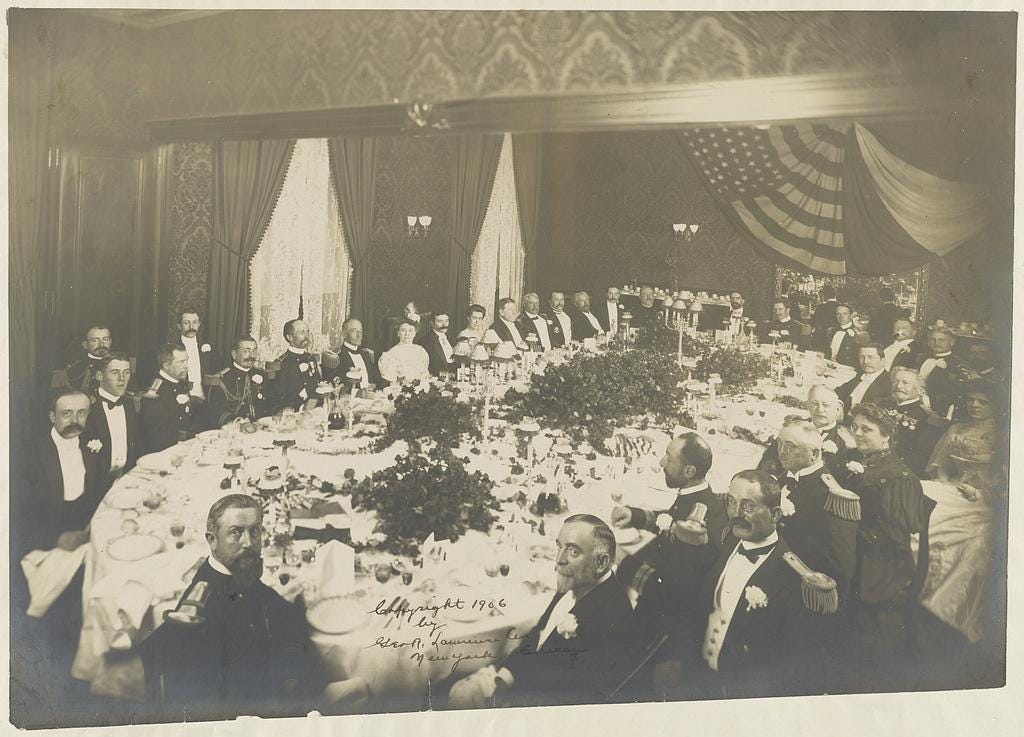
Alongside the democratic oyster sat a more explicitly exclusive set of foods. Terrapin, a freshwater turtle, became the darling of New York high society in the late nineteenth century, stewed in rich sauces and served in the city’s most prestigious hotels and private clubs.
Believe me: If you were eating terrapin, everyone knew exactly where you stood.
Game held the same power. Venison, pheasant, grouse, and canvasback duck carried weight that oysters never could, because you couldn’t buy your way into them at a street stall. These were the spoils of land ownership, of seasonal hunting rights, and of long, unhurried days on private estates and shooting grounds.
And so, game on the table became a message. It whispered of countryside estates, sporting privilege, and the tangled networks of inherited wealth that a self-made millionaire could not simply purchase overnight.
The menus from elite hotels—Delmonico’s chief among them—lay out carefully ordered processions of fish, game, and roast meats, each course arriving in its appointed place. That order was very intentional; it was French haute cuisine and formal etiquette dictating the rhythm of the evening.

Aspic and the Art of Edible Spectacle
One of the most unmistakable flourishes of Gilded Age dining was aspic.

Aspic is a savoury jelly made from clarified meat stock, used to suspend meat, fish, eggs, and vegetables inside glittering decorative moulds. In elite kitchens it became a badge of technical mastery and a small miracle of engineering.
(Though, by today’s standards, it reminds be a bit of the unappetising Jell-O creations in 1970s kitchens.)
