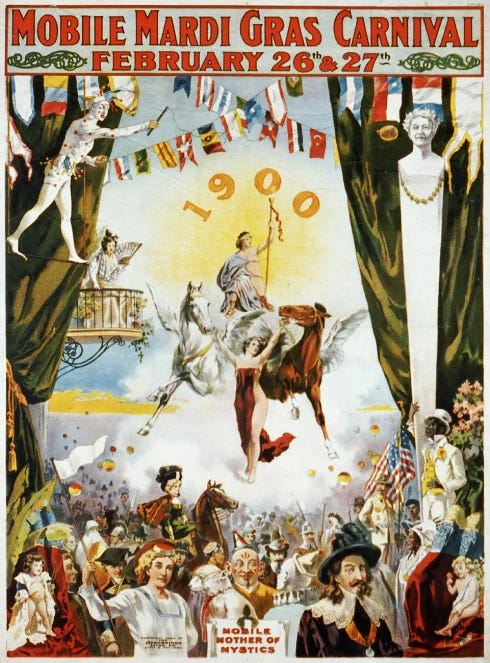
For all its rigidity and ritual, the Gilded Age was not an era that rejected indulgence. It simply insisted that indulgence be carefully timed, tightly managed, and socially contained. Pleasure and excess were permitted, provided they were regulated and did not threaten the structures beneath. Enter: Mardi Gras.
With its masks, music, parades, and lavish balls, the celebration appeared to offer a rare suspension of order. Yet beneath the spectacle lay an intricate system of control. The hierarchies which governed society may have been dressed up, paraded through the streets, and, on the surface, discarded, but were nonetheless returned neatly to place when the season ended.
In the Gilded Age, Mardi Gras became one of the most extravagant and symbolically charged events on the social calendar, a moment when society flirted with disorder while ensuring it never truly arrived…

The Origins of Mardi Gras
Mardi Gras, meaning ‘Fat Tuesday’, marks the final day of feasting before the beginning of Lent, the forty-day period of fasting and reflection in the Christian calendar. Its origins lie in medieval European carnival traditions, where communities indulged in rich food, drink, and celebration before the restraints of the religious season took hold.
These traditions travelled across the Atlantic with French and Spanish settlers and took root most firmly in New Orleans, where Catholic observance, colonial heritage, and later American influence combined. Over time, Mardi Gras evolved beyond its religious function, becoming a civic event that blurred the lines between ritual and spectacle.
By the 19th century, Mardi Gras in New Orleans was no longer simply a marker of the liturgical calendar. It had become a major social occasion, drawing on European pageantry while developing distinctly local traditions.