

Gilded Age Deep Dive: Edward VII (a.k.a. The Playboy Prince)
The prince everyone wanted to know… and every mother warned her daughter about.

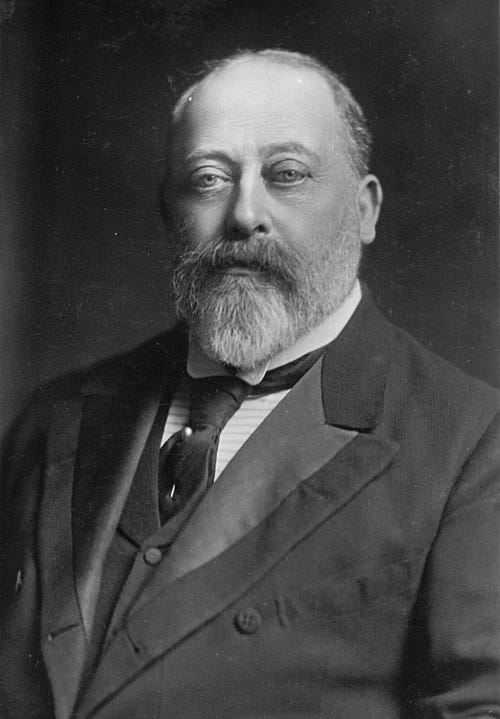
By the time Edward VII finally inherited the British throne in 1901, he was approaching sixty, carried more than a little evidence of a life well lived around the waist, and had already spent four decades becoming one of the most recognisable, discussed, gossiped-about, and, depending on whom you asked, exasperatingly charming men in Europe.
To the public, he was the Prince of Wales. To his friends, he was simply “Bertie”. To his mother, Queen Victoria, he was often a source of profound disappointment. And as she spent a great deal of her reign trying to uphold an image of domestic virtue and moral seriousness, her eldest son was building something entirely different: fame.
Long before he wore a crown, Bertie had become a kind of nineteenth-century celebrity. And across the Atlantic, where America’s newly minted millionaires were busy turning industrial fortunes into social ambition, they could not seem to look away…

Born to Rule… But Rather More Interested in the Guest List
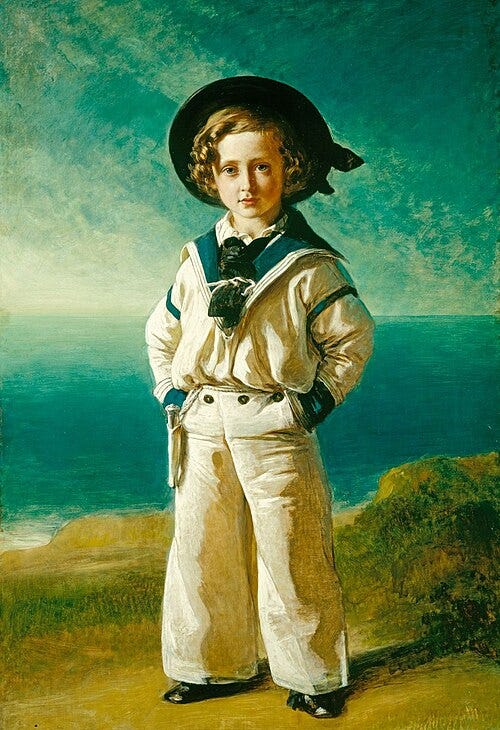
Born in November 1841 at Buckingham Palace, Albert Edward was the eldest child of Victoria and her beloved husband, Prince Albert, and from the moment of his birth, it was assumed that he would one day embody the moral and intellectual ideals his parents held so dear.
Albert, in particular, approached his son’s education with almost Teutonic seriousness, overseeing a programme of study so rigid that one can only imagine even the tutors occasionally needing a restorative brandy. Bertie was expected to master languages, history, constitutional theory, religion, military discipline, and the art of behaving impeccably while everyone watched.
Unfortunately for everyone involved, Bertie seemed far more interested in people than in books, in horses than in philosophy, and in dinner parties than in constitutional theory. His tutors described him as warm, affectionate, and sociable, though not especially scholarly, and while this no doubt caused Prince Albert considerable concern, it would eventually prove to be one of Bertie’s greatest assets.
He may never have become the academic prince his father had envisioned, but he possessed something arguably more useful: he understood people instinctively, remembered faces, listened carefully, charmed effortlessly, and, perhaps most importantly, knew exactly how to make others feel that being in his orbit mattered.

Marlborough House: Where Respectability Went for a Little Lie Down
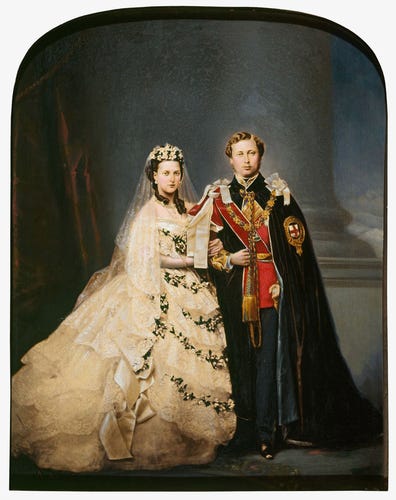
After his marriage in 1863 to Alexandra of Denmark, one of the great beauties of her generation, Bertie took up residence at Marlborough House, and it was here that his real influence began to take shape. If Victoria’s court at Windsor Castle represented duty and decorum, Marlborough House represented something altogether more wild.
