

Inside a Gilded Age Cookbook...
...including a peek inside my new book!

A small piece of news at the top, in case it hasn’t reached you yet…
…I wrote a book! It is called Secrets of an English Country House: A Year at Mapperton, and it officially drops on the 24th of September 2026.
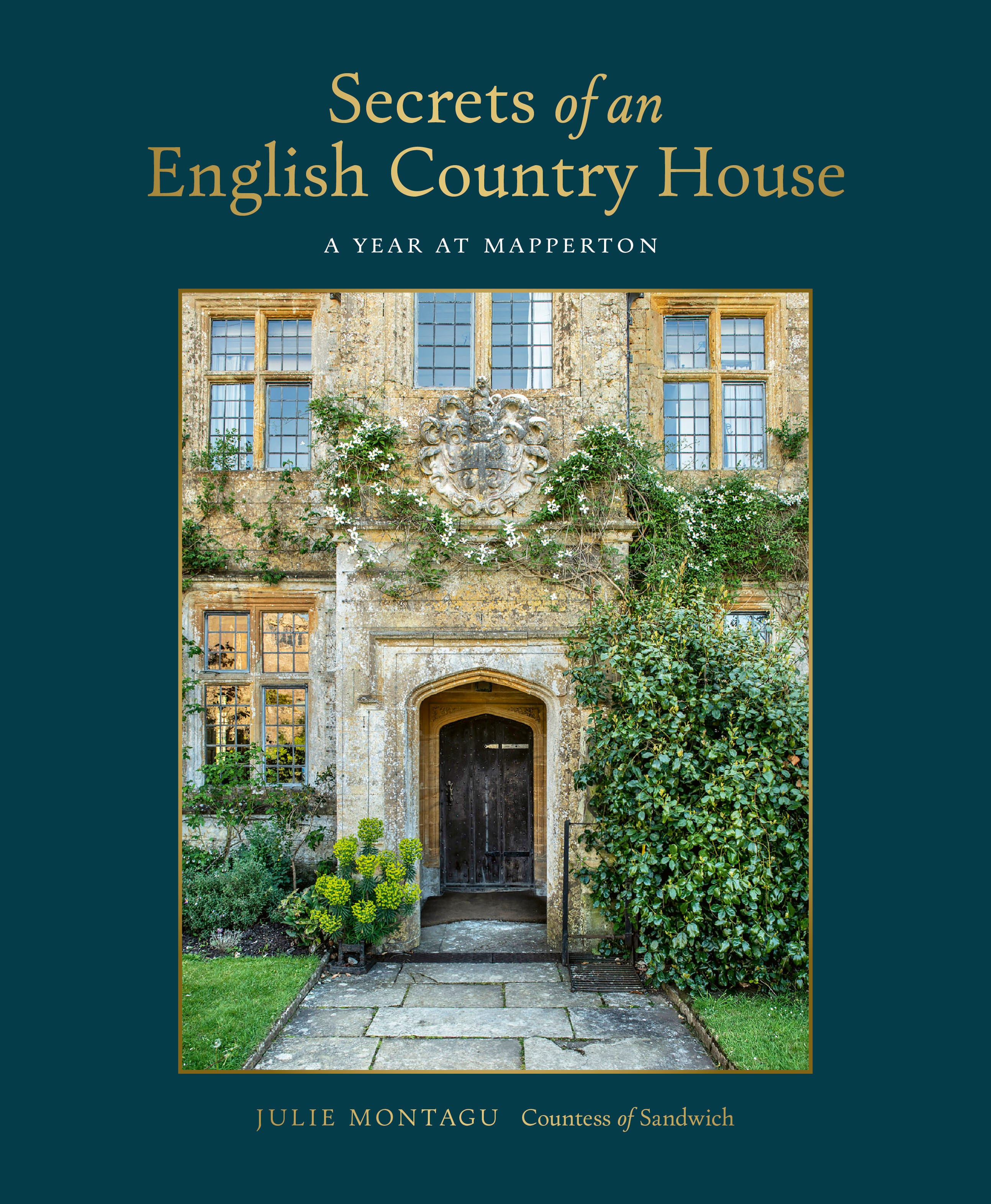
But preorders are open now…and they come with some pretty great perks!
I’ll tell you everything about it at the bottom of this post.
But first I want to give you something better than an announcement. I want to actually let you inside the book.
So today’s piece is the first proper sneak peek. It’s a small extract, lightly stitched together, from one of the threads that runs through the book: the Gilded Age dinner table, and what happened to it when American heiresses started carrying it across the Atlantic into English country houses.
Pull up a chair.

Picture a Tuesday evening in February 1885. The Astor dining room on Fifth Avenue. Twenty-four guests, all of them on Mrs. Astor’s list of Four Hundred—the precise number, the legend went, that her ballroom could comfortably hold. The table is laid for nine courses, and somewhere in the kitchen a French chef is finishing a sauce that took three days to build.
Each place setting carries a small printed card, in French, listing the meal in order. Each guest has been seated, by the hostess, with the kind of strategic care that elsewhere in history is reserved for diplomatic summits. To her right: the most important man in the room. To her left: the second-most. The widow next to the bachelor. The bishop nowhere near the divorcée, of course.
This is what dinner looked like in the Gilded Age. It was the period’s defining performance. It was more important than the ball, more revealing than the box at the opera, and more politically consequential than almost anything else a woman of fortune could host. To be invited was to exist socially. To be left out was to vanish.
And underneath all of it—the silver, the menu cards, the seating diagrams, the velvet—was something far stranger and more interesting: the food itself.
Service à la russe, or: how to eat for three hours
Up until the middle of the nineteenth century, formal dinner in the English-speaking world was served à la française; every dish placed was on the table at once in a kind of edible centrepiece. Diners helped themselves from whichever platter was within reach. It was beautiful, and almost everything went cold.
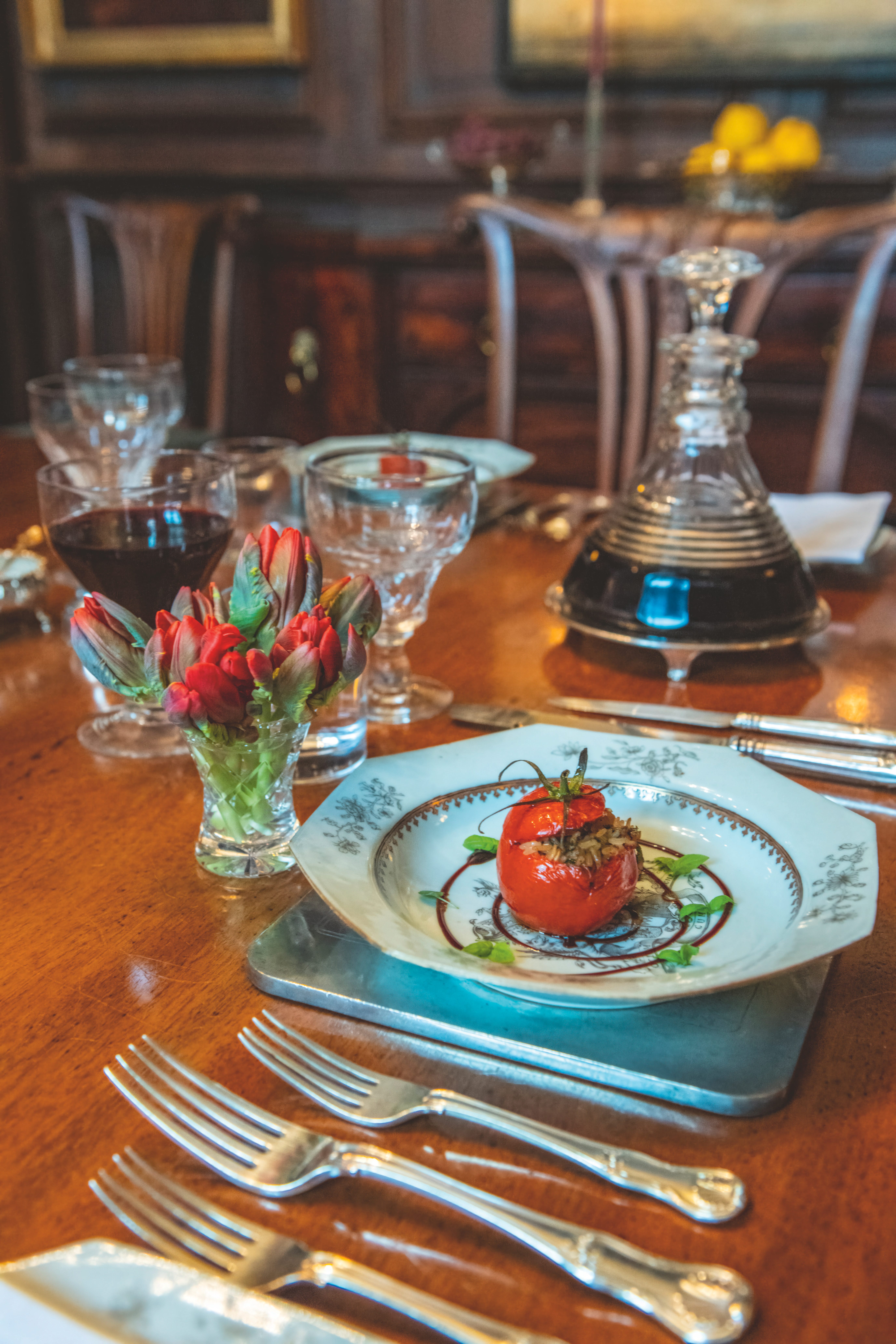
By the time the Gilded Age arrived, the French had—confusingly—handed over their own old style and adopted the Russian one instead. Service à la russe meant courses brought one at a time, plated, often warm, in a strict and theatrical sequence. The hostess no longer presided over a groaning table; she presided over an arc.
A typical Gilded Age dinner ran eight to twelve courses: oysters, soup (clear or thick, never both), a fish course, an entrée, a roast, a sorbet to clear the palate, game, salad, cheese, dessert, savouries. Champagne with the oysters, sherry with the soup, claret with the meat, sauternes with the dessert.
Each course had its specific cutlery, which is where the much-mocked twenty-fork place setting came from. It was choreography. The fork told you what was coming next.
The cult of the French chef
There is a reason every menu card in 1880s New York was printed in French. Cooking, in this era, meant Paris. The great American hostesses competed not only on their guest lists but on the provenance of their kitchens.
At Delmonico’s—the restaurant where Mrs Astor and her circle effectively rehearsed before they performed at home—the chef was Charles Ranhofer, a Frenchman who had worked at the Tuileries. He invented Lobster Newberg, Baked Alaska, and at least the New York version of Eggs Benedict, and he wrote The Epicurean (1894), an eleven-hundred-page bible of haute cuisine that any serious Gilded Age household kept on a shelf.
If you couldn’t lure a Ranhofer-trained chef to your own house, you sent your housekeeper to Paris to train. If you couldn’t do that, you bought The Epicurean and pretended.
The point was the same in every case: the kitchen was foreign, the menu was foreign, the language was foreign, and the message, beneath all that translation, was that this household had access. Access to talent, to taste, to a Continental world the merely wealthy did not.
The menu card
We talk about the dinner. We rarely talk about the small printed object beside each plate.
Gilded Age menu cards were keepsakes. They were printed on heavy stock, often with a small ornamental border or hand-drawn illustration like a sprig of violets, a heraldic crest, or a tiny gilded line of seashells for a Newport summer. They listed the courses in sequence, the wines, sometimes the names of the guests, sometimes a verse or a date. They were collected, pasted into albums, sent to mothers. They are, frankly, why we know what these people ate.
And because the cards were French, the dishes were French…even when, as was often the case, the cook was Irish or German or American, and the duck had been raised half a mile from the back door. Canards aux Cerises sounded more imposing than “duck with cherries.” It still does.
The mathematics of the hostess
Above all the menus and the chefs and the wine-pairings sat the woman holding the seating plan.
Mrs Astor’s power did not come from her wealth; there were richer women in New York. It came from her dinners. Her social secretary Ward McAllister, who coined the “Four Hundred,” described the placement of guests as a discipline more rigorous than law. Wrong neighbour, ruined evening. Wrong evening, ruined season. Wrong season, your daughter doesn’t marry.
An invitation to one of these dinners was a license. A second invitation was a status. A first invitation withdrawn was the social equivalent of a verdict.
Edith Wharton, who grew up inside this world before she escaped from it, called it “a kind of hieroglyphic world, where the real thing was never said or done or even thought, but only represented by a set of arbitrary signs.” The dining room was the room where most of those signs were written.
And then the heiresses crossed the Atlantic
When American Dollar Princesses began marrying into British country houses in the 1880s and 1890s, they carried this whole apparatus with them. They carried the expectation that dinner would be French, the expectation that there would be a printed card by every plate, and the expectation that a Tuesday in November in a draughty Dorset hall could and should look—at the table, at least—like a Tuesday in February on Fifth Avenue.
Some of them brought their own cooks. Some of them brought recipes copied out by their mothers. And some of them brought their own typewriters and began compiling cookbooks of their own.
Which brings me, inevitably, to Alberta.
Alberta’s cookbook
Alberta Sturges, who was born in 1877, married to George Montagu, the 9th Earl of Sandwich, in 1905. She was the last Countess of Sandwich to live at Hinchingbrooke, and she kept a typed cookbook.
And I found it.
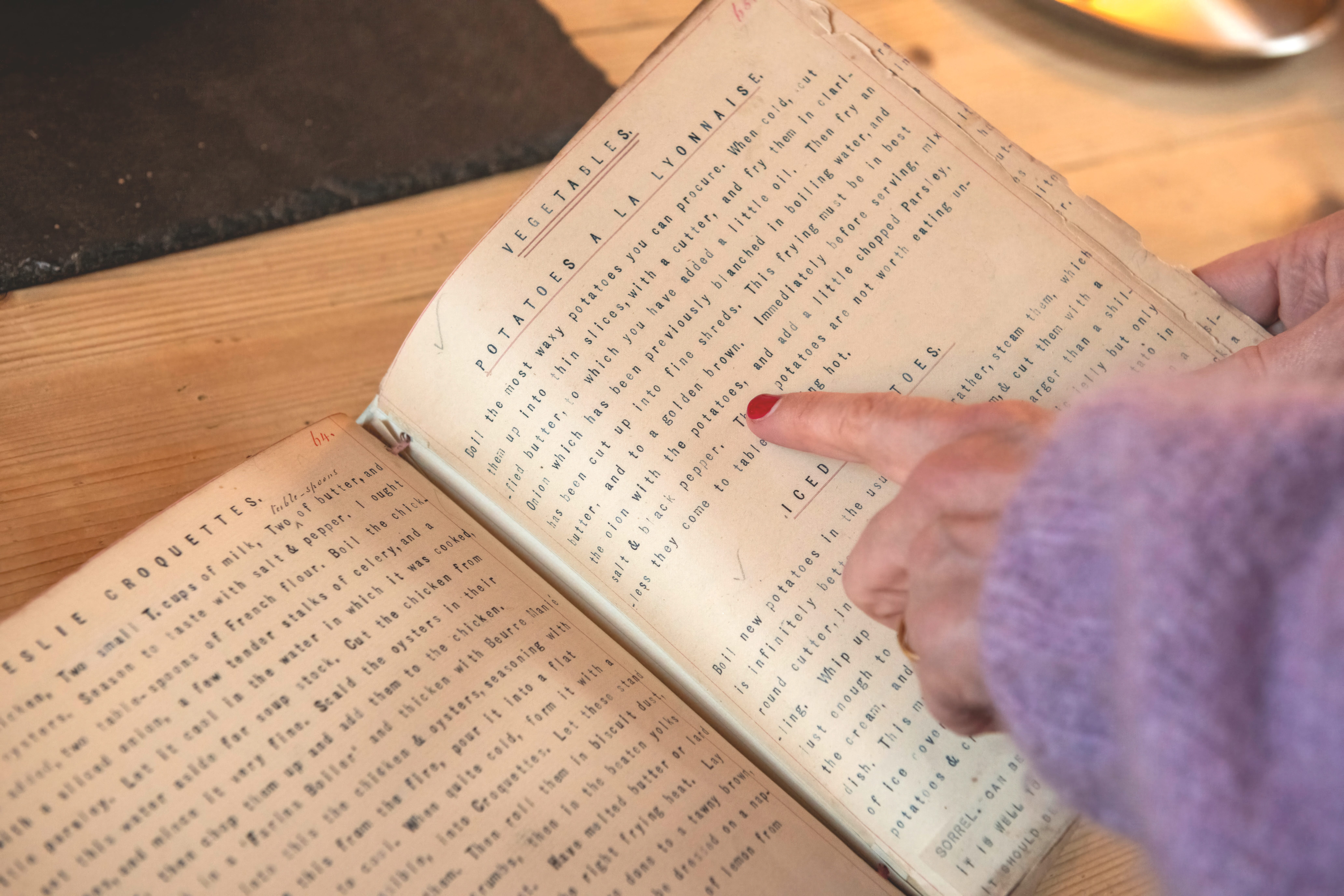
It is not a grand object. It is a small, working, domestic thing: typed pages, the recipes written out in her own clipped, particular voice, the hand of an American woman who had absorbed the French menu of her New York girlhood and was now running an English country house with it.
Her duck recipe begins, in true period style, with the assumption that you can roast a duck:
Canards aux Cerises
“Roast a duck, wild or tame, and see to its being rather underdone” — to be served, of course, with a sauce of preserved cherries.
Mousse de Chocolat
“For 6 persons, place 2 tablets of a slab of chocolate in a stewpan . . . add whipped cream & a trifle of powdered sugar.”
Tomates Farcies
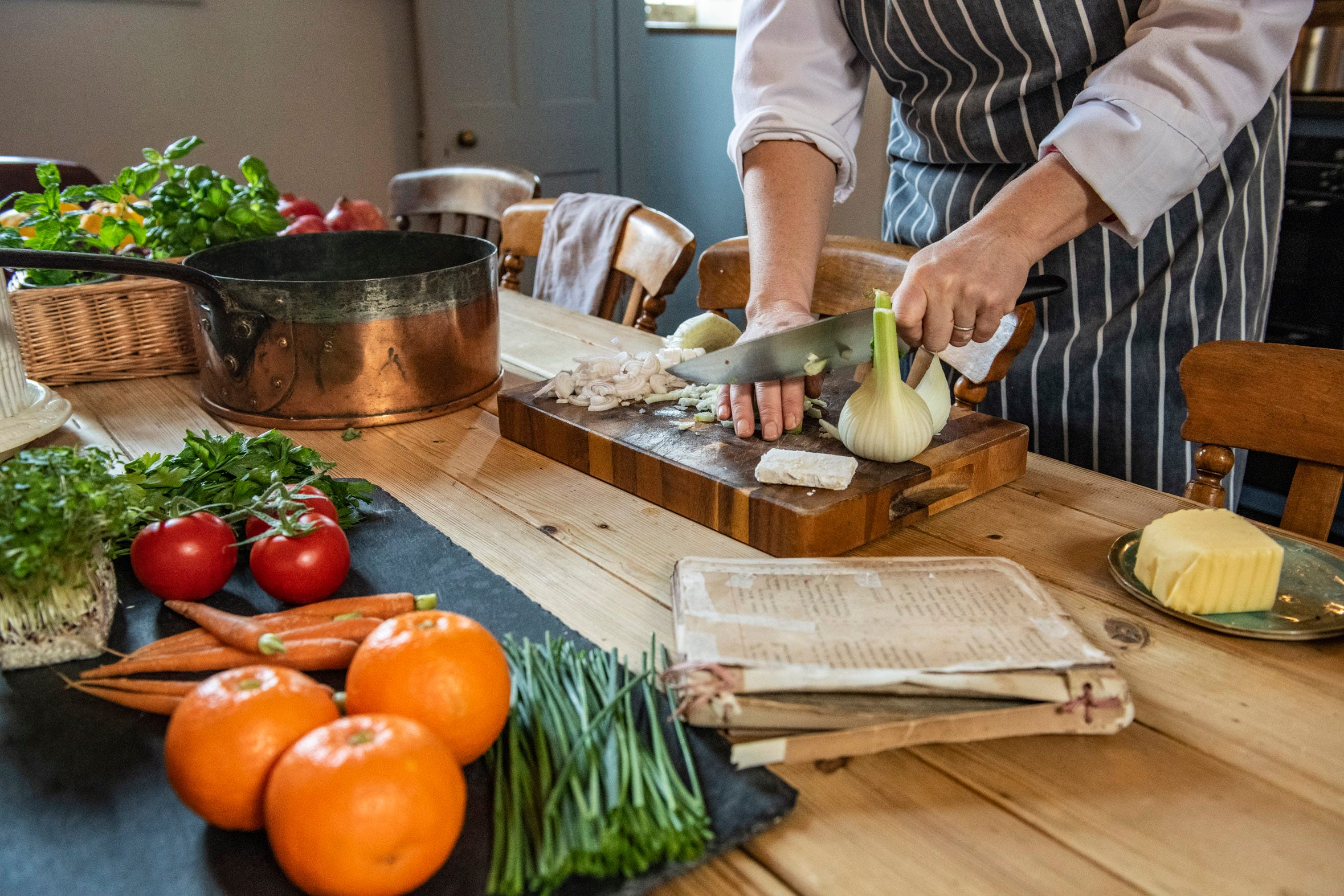
Tomatoes filled with butter, onion, fennel and rice — a Continental side dressed up enough for an English table.
These aren’t exactly famous dishes. Instead, they are something far more interesting: the daily, real, livable end of the Gilded Age dinner—the bit that survived the passage to England, the bit a young Countess actually wanted to feed her family and her guests, the bit that fits on a typed page in a Dorset attic and waits a hundred years to be read.
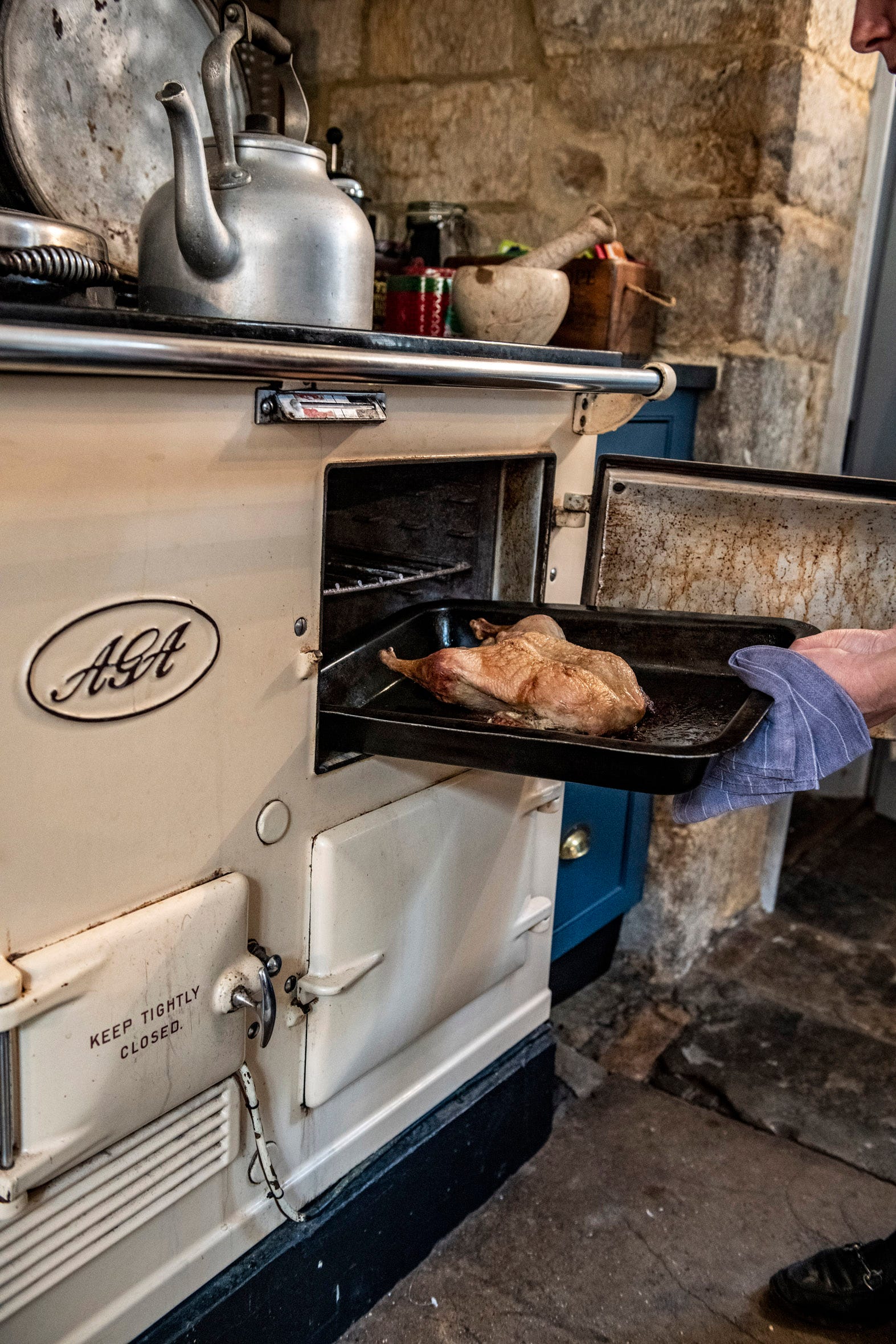
We have, in the last few seasons, started cooking from it again at Mapperton. The recipes have become the heart of what we now call the American Heiress Suppers: small candlelit dinners staged as part of our Grand Historic Tours, where the menu is Alberta’s and the table is set the way she would have set it. The Canards aux Cerises tastes, more or less, the way it tasted in 1908.
So…about the book
That cookbook, the candlelit suppers it now feeds, the dressing for dinner, the imported French menu, the seating plans Alberta inherited from a New York girlhood and rewrote for a Dorset dining room…
…these are some of the threads I follow inside Secrets of an English Country House.
Two of the chapters belong specifically to Alberta. One on the research and the archive, including the nearly ten thousand letters she left behind, the volunteer team transcribing them, the AI my husband Luke has built from her own correspondence, and more.
The other on what she left behind in objects: the journals, the devotional book of pressed flowers, the 1914 House of Worth gown that turned up in a trunk of seventeenth-century armour, and the typed cookbook.
The rest of the book is a full year at Mapperton, January to December: the house, the family, the collection, the gardens, the rewilding, the volunteers, the team.
And the photographs, honestly, are the best work we have ever done.
Publication day is the 24th of September 2026.
Pre-orders are open now, and if you order before the 23rd of September and complete the claim form, there are also a few thank-you gifts I have put together with the publisher:
If you’re already a Mapperton Live Patron:
A place at an exclusive online Patron-only Q&A with me after publication; a monthly digital gift, including a scrapbook of unpublished images that didn’t make the book, a Mapperton calendar…and more!; a Patron-only signed downloadable bookplate; and others still to be announced.
If you’re not yet a Patron:
Three free months of Mapperton Live at Hogarth (level 3), starting on publication day; a place in the draw for one of one hundred spots in a live online Non-Patron Q&A with me; a signed downloadable bookplate the moment you complete the form; and a real, mailed-to-you Christmas card from Luke and me, posted in December.
Thank you, as ever, for sitting at this table with me. There is a great deal more like this inside the book—more Alberta, more dinners, more strange and beautiful things turning up in trunks they had no business being in—and I cannot wait, in September, to put a copy in your hands.
With love,
Julie
I've pre-ordered your book but don't know how to fill out the claim form.
I think the tablescape not including your book is lovely. I see those glasses with the Montague Crest on them